
Disclosure: If you buy something via our link, we may earn a commission with no additional expense to you. As an Amazon Associate, I earn from qualifying purchases. Learn more

Ranking The Best from 70+ Refractor Telescopes

Post date

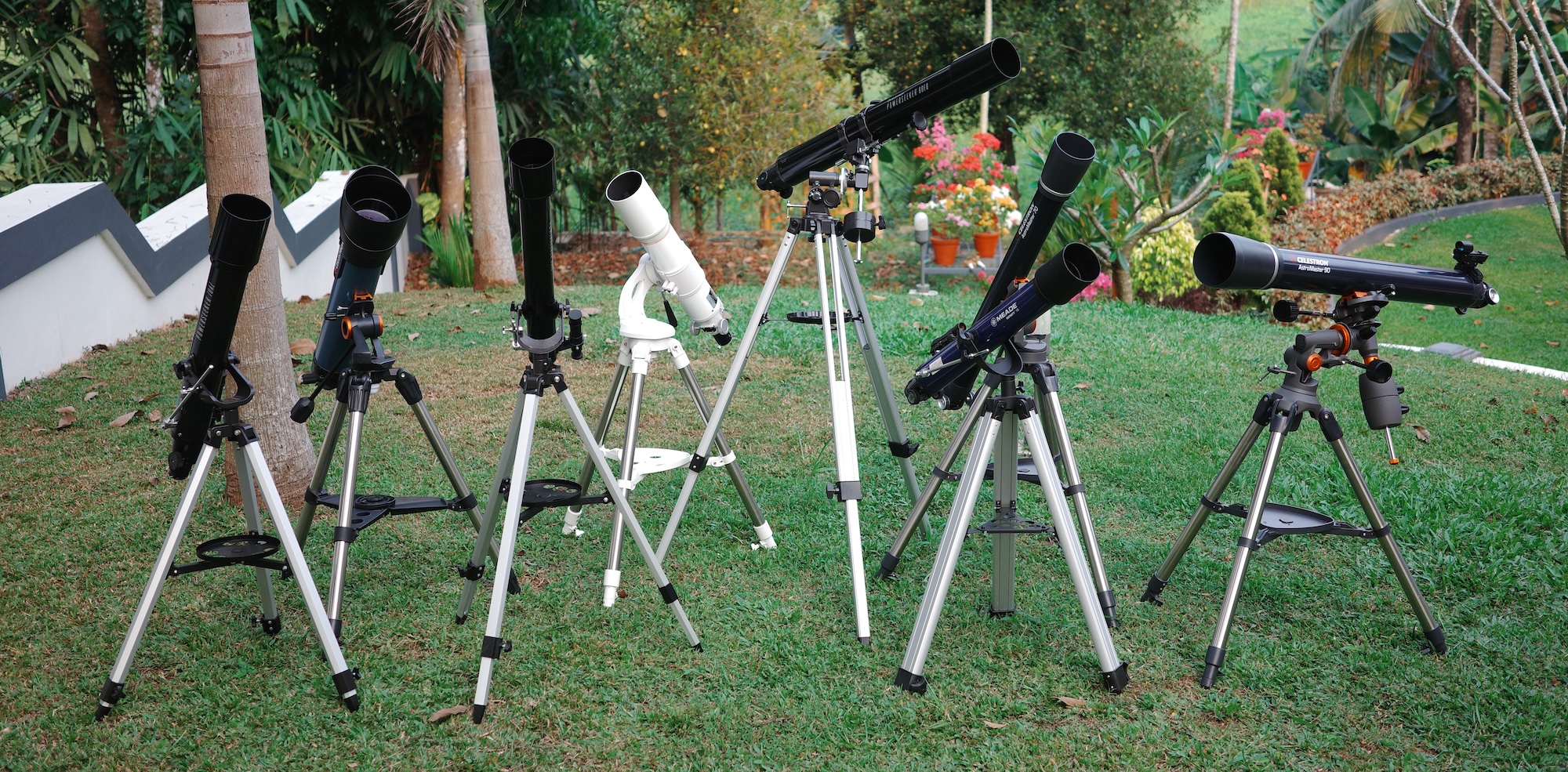
Refractor telescopes from Celestron, Meade, and Explore Scientific
A few of the refractors from Celestron, Meade and Explore Scientific that we've had in our garage.

In my view, a small refractor, particularly on an easy-to-operate alt-azimuth mount, is unmatched in convenience. Even on a chilly night, I can be observing in minutes—if not seconds—since, unlike with my reflector and catadioptric telescopes, I don't need to wait for the optics to cool down to the outside temperature or perform a collimation procedure. I always keep a small refractor by the back door of my house for spur-of-the-moment observing. Even if I leave it unmaintained there, I don't have to worry about the mirror coatings degrading over time.

Finding deep-sky objects is no problem, thanks to the refractor's wide field of view. Refractors' higher visual contrast and tolerance of inexpensive eyepieces, compared to reflector or catadioptric types of telescopes, are just the icing on the cake. I've stumbled upon many deep-sky objects that are so big and low in contrast that they are only visible through my small refractor.

However, refractors are much more expensive than equivalent-aperture reflectors or catadioptrics. Additionally, due to the difficulties and costs of making a large lens and properly mounting such a massive telescope, refractors are rarely found above 6 inches in aperture. Those that do exist tend to be extremely expensive and bulky.

Throughout this list, you'll come across the term 'chromatic aberration', a key reason I don't recommend many of the cheaper refractors. This optical issue, which produces fuzzy images and purple halos around bright targets, occurs in budget refractors because refractor lenses without extra-low-dispersion (ED) glass or additional elements can't focus all colours to the same point. The problem becomes more pronounced with larger lenses and longer focal ratios.

The three commonly available types of refractors are achromats, ED achromats, and apochromatic (APO) refractors, which you can think of as the low, medium, and high-priced options on the market.

  • If you're a visual observer, achromats might be just what you need. These refractors are less expensive to manufacture and can be purchased for as little as £100. They work acceptably at longer focal ratios and with smaller apertures.
  • If you are an astrophotographer, consider the ED doublets as your entry-level models, with the APOs as the premium models. I know several people who paid five to ten thousand pounds—sometimes more—for apochromatic designs for perfect chromatic and other aberration control from brands like Stellarvue, Astro-Physics, and Takahashi.
  • For the hobbyist on a budget, I believe a long focal ratio achromat, an ED doublet, or an inexpensive apochromatic triplet will more than suffice for visual use and photography with a DSLR or modest CCD camera.
  1. Achromatic refractors have objective lenses based on two elements, typically made of crown and flint glass, and exhibit varying levels of chromatic aberration depending on the aperture and focal ratio.
  2. ED doublets, also known as ED achromats or semi-apochromats, reduce chromatic aberration to an acceptable level (but not nonexistent), although at higher prices. ED doublets use FPL-51, FPL-53, or FCD100 glass in one of the elements of the objective lens to make this possible.
  3. Apochromats use 3 or sometimes more lens elements in their objective lenses, usually with at least 1 ED lens element. In addition to colour control, adding more lenses can lead to more pleasing astroimages with less field curvature, lesser edge-of-field aberrations, and other issues that are particularly evident with large CCD imaging chips.

We've written a standalone article on Apochromatic Refractors vs Achromatic Refractors if you'd like to read more in detail.

Rank Category: Below £175 Refractor Telescopes

Cheap refractor models have more chromatic aberration, cheaper accessories, cheaper mounts, and lower build quality than a more expensive refractor. Unfortunately, there aren't many refractor telescopes we can confidently recommend below £175, though there are plenty of options available on the market.

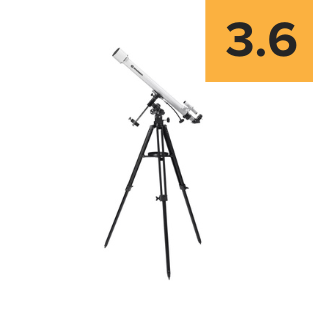
Bresser Classic 60 EQ Refractor
The Bresser Classic 60EQ is well-made and includes a nice mount and accessories, but its tiny 60 mm aperture limits what you can see to little more than the Moon, planets, and double stars.
[table “43” not found /]

Rank Category: £175-£300 Refractor Telescopes

Sky-Watcher Evostar-90/660 AZ Pronto
The Sky-Watcher Evostar-90/660 AZ Pronto is one of the better cheap 90mm telescopes out there, if a bit lacking in accessories. It’s hard to argue with its good optics, simple and sturdy mount, and almost unmatched convenience as a great “portable” scope.
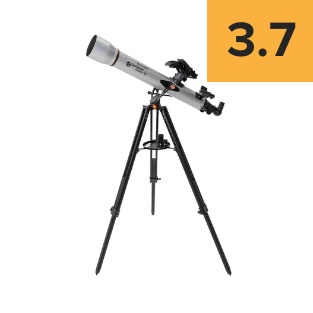
Celestron StarSense Explorer LT 80AZ Refractor Telescope
The StarSense Explorer LT 80AZ gets you a lot for your money, bearing in mind that it’s still a mediocre 80mm refractor. While it has decent optics and a fairly acceptable set of accessories, it's mounted on a poorly constructed alt-azimuth fork mount.

It’s very easy to aim, thanks to Celestron’s unique StarSense Explorer technology, which uses only a smartphone app and a special phone-mounting adapter to assist us in pointing the telescope at faint deep-sky objects without any additional hardware, alignment, or power.

Given its small 80mm aperture and narrow field of view due to the long f/11 focal length, we still question its purpose since there are probably only a dozen practical targets where the StarSense Explorer app might be of any benefit. However, it is nonetheless a pretty good deal for the price, and we're impressed with how the StarSense Explorer system actually manages to work.

Rank Category: £300-£500 Refractor Telescopes

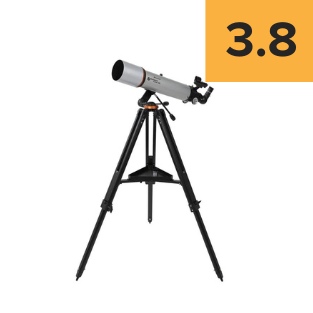
StarSense Explorer DX 102AZ
The StarSense Explorer DX 102AZ fixes many of the issues of its smaller cousin, the StarSense LT 80AZ, and it’s one of our favourite pick-up-and-go refractor telescopes. It has great optics (albeit with slight chromatic aberration expected at the focal ratio of f/6.5), an easy-to-use alt-azimuth mount, a sturdy tripod, and a decent supplied eyepiece and finder.

The StarSense Explorer technology, which helps you point the telescope using a smartphone and a phone bracket, is a nice bonus that’s included for essentially no extra cost. We've also noticed that the smartphone mounting bracket on the DX mount is a little better designed than what’s provided with the StarSense LT 80AZ telescope, and so the StarSense Explorer tech works a little more accurately.

While the DX 102AZ technically includes a fairly good 2" metal focuser, in our experience, the included mount is not exactly up to the task of handling heavy 2” eyepieces and a beefy diagonal.

However, with a price tag big enough to obtain a larger and/or fully computerised non-refractor, the DX 102AZ is not the most economically justifiable scope unless you specifically want a refractor.

[table “45” not found /]

Rank Category: £500-£1000 Refractors
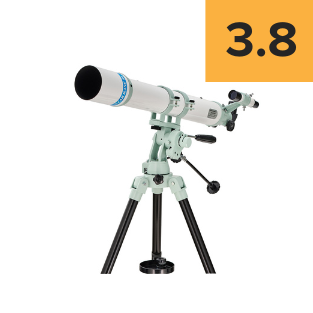
Takahashi Starbase 80
The Takahashi Starbase 80 is an extremely high-quality achromatic refractor. It’s great for beginners, and it is probably one of the highest-quality achromats on the market today. However, for a bit more money, you could just get an apochromat, which is more compact and suitable for imaging, though Takahashi’s products in this category are equally extremely expensive for what you get.

Rank Category: Above £1000 Refractors

Unfortunately, there are no all-in-one telescopes on this list that we can say with confidence are capable of serious deep-sky astrophotography right out of the box.
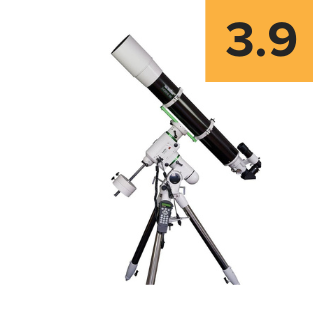
Skywatcher Evostar 150 NEQ6 Pro GOTO Telescope
[table “47” not found /]

Rank Category: Imaging Refractors

We have a separate ranking page for optical tube assemblies (OTAs), which also includes refractors—these are geared more toward imaging, unlike the visual-focused refractors listed above.