
Mechanics
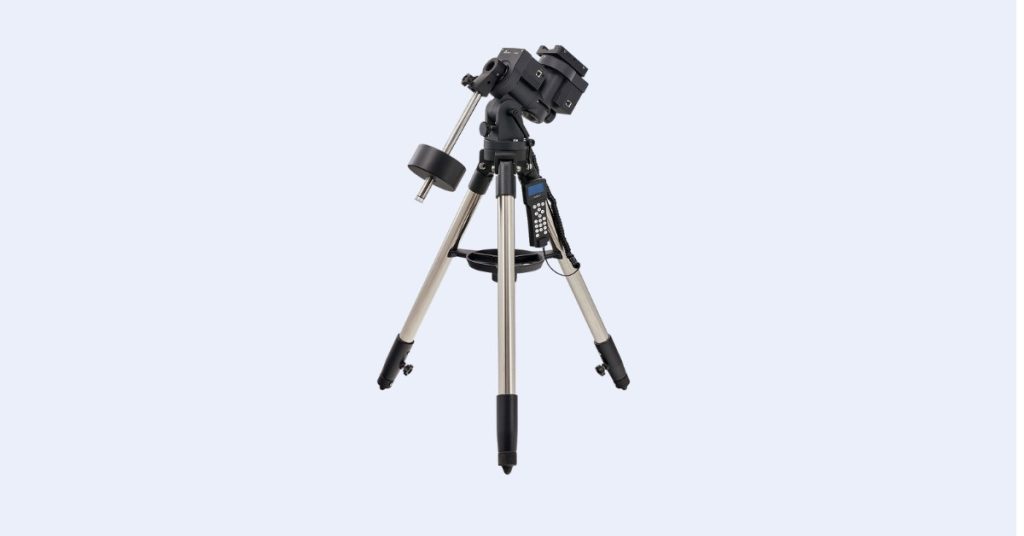
The iOptron CEM26 consists of a compact mount head that can rotate on two axes and a sturdy stainless steel tripod with adjustable legs and a built-in spirit level. The mount head has a saddle plate that can accommodate either a Vixen or a Losmandy-style dovetail bar, allowing it to hold a variety of telescopes or cameras. The mount head also has a built-in carry handle and a snap-in battery pack that can power the mount for up to 10 hours.
The CEM26 uses a unique center-balanced design that places the center of mass over the tripod, reducing the torque needed and increasing the stability of the mount. This means that the mount can support up to 11.8 kg of payload (iOptron claims up to 15 kg if you switch to the LiteRoc tripod or a pier, but I wouldn’t try it). This also means that the mount does not need as many counterweights to balance the load, saving weight and space.
The design also has the declination shaft away from the polar scope, meaning the polar scope is never obstructed by the declination axis.
iOptron supplies a single 4.5 kg counterweight with the CEM26. For imaging use, it is likely all you need, though the shaft’s 20 mm standard diameter means it accepts most counterweights made for other mounts in addition to the ones iOptron sells.
The CEM26 uses a belt-driven dual-axis stepper motor system that provides smooth and quiet operation with low backlash and low periodic error. The mount can track at four different speeds (solar, lunar, sidereal, or custom) and can slew at up to 6 degrees per second.
The mount also has a built-in dual encoder system that ensures the mount does not lose its alignment even if it is accidentally bumped or moved. The dual encoders also allow you to manually aim the CEM26 without affecting the accuracy of its tracking or star alignment.
The CEM26 is lighter than most similar mounts in its class, with the mount head weighing only 4.5 kg and the LiteRoc tripod weighing 5 kg.
The LiteRoc tripod is made of aluminium and has legs that can be adjusted and a spirit level that is built-in. It provides some stability for the mount and the load, but for heavier or larger setups, it may be too wobbly. The tripod also has a tray for storing the hand controller or other accessories. The iOptron TriPier can also be used with the CEM26 for more robustness and stability.
The CEM26 has a basic Vixen-style dovetail saddle, which I would highly recommend you replace with an aftermarket dual Losmandy/Vixen saddle from ADM so you can use either size dovetail plate and have a more solid connection with your telescope’s dovetail bar. The stock saddle has no safety mechanism and clamps to your dovetail with a single knob. The clamping system won’t mar your dovetail with bit marks, but it is bad to rely on a single point of failure for attaching your optical tube and astrophotography gear, especially when said kit can cost more than a nice car.
Balancing a telescope on the CEM26 is a little different from what you might be used to with a regular German equatorial mount. Your scope and the declination axis are to the rear of the counterweight, so it might take a bit to sort out how much counterweight you need for the RA axis and where your optical tube/rings need to be to balance on the declination axis. However, once you’re used to this, you’ll practically forget there is anything at all out of the ordinary with the CEM26 compared to any other mount.
Electronics
The iOptron CEM26 features a Go-To system that can automatically point to over 200,000 objects in the sky, such as planets, stars, nebulae, galaxies, and more. The mount also has a built-in GPS and WiFi module that can provide accurate time, location, and alignment data.
The CEM26 comes with the iOptron Go2Nova hand controller. This controller has various settings for speed, backlash compensation, and, of course, how you align and point the mount in the night sky. However, like all hand controllers, it’s far from intuitive or convenient to use, and as such, you might want to take advantage of the CEM26’s inbuilt WiFi module or USB port and operate it via your smartphone, tablet, or PC instead.
You can use the official iOptron Commander, which can be downloaded for free from the App Store or Google Play. The app can connect to the mount via WiFi and provide a graphical interface for controlling the mount and selecting objects, as well as assist in polar alignment. While not free and not able to help with doing a software polar alignment, the SkySafari Pro app is a lot more intuitive than the Commander app and will also work to remotely control the CEM26.
A PC can also be used to control the CEM26 mount via ASCOM drivers that can be downloaded from the iOptron website. The PC can be connected to the mount via a serial cable or wirelessly, with the mount’s WiFi adaptor. A PC can provide more options and features for controlling the mount and interfacing with other software, such as planetarium programmes, imaging software, or autoguiding software.
The CEM26 mount also has an autoguider port that can accept a standard ST-4 cable from an autoguiding camera or device. An autoguider is a must-have for any mount, including the CEM26, as it will help with correcting the inevitable tracking errors or drifts of the mount during long-exposure astrophotography before they build up and ruin your images.
Like the GEM28 and other iOptron mounts, the CEM26 is available in a number of variants—as well as the different tripod options.
Using the iOptron CEM26 for Visual Observation
The iOptron CEM26 is a versatile and convenient mount for visual observation with a variety of telescopes. To use the mount for visual observation, you will need to attach a telescope to the mount with a dovetail bar. You will also need to level the mount, conduct a rough polar alignment, and align the mount on the sky with your control method of choice (Go2Nova controller, app, or PC). If you’re using the controller or a smartphone/tablet, GPS data will automatically update the date, time, and location of the mount thanks to its onboard sensors. Once alignment is complete, the CEM26 mount will then automatically slew to and track objects.
The CEM26 is reasonably user-friendly to operate via the Go2Nova controller or with your smart device, and of course you can always unlock the clutches and aim the mount manually thanks to its built-in encoders. The mount can track at sidereal, lunar, or solar speeds, depending on the object you are observing. The mount can also track at custom rates, which can be useful for observing objects that have different apparent motions, such as comets, asteroids, or satellites.
The CEM26 is rated to hold up to 12.7 kg., or 15 kg. with the LiteRoc or another sturdier tripod. However, in practise, 9-11.3 kg is the realistic limit of this mount’s capacity, and even then only for non-critical applications like visual observing. This corresponds to a 9.25” Cassegrain, a 6-8” reflector, or a 6” refractor. Overloading the mount above this limit is going to lead to vibration issues long before it actually becomes too heavy for the mount itself to function.
Using CEM26 for Astrophotography
The iOptron CEM26 is a capable and user-friendly mount for astrophotography with a camera and a lens or a small- to medium-sized telescope. You can control the mount the same way you would for visual observing (i.e., via your phone or the Go2Nova hand controller), but I would recommend plugging it into a PC.
The CEM26 can hold up to about 6.8 -9 kg for astrophotography purposes (the rule of thumb being that a mount can hold ⅓ to ⅔ of its weight rating for astrophotography). This corresponds to an 8” SCT or Ritchey-Chretien, a 4” refractor, or an 8” Newtonian reflector. Larger telescopes will be unsteady and induce tracking errors in the mount.
If you’re finding yourself needing an additional counterweight for the CEM26 to supplement the provided 4.5 kg one, stop—your rig is getting too heavy for this mount, with or without the LiteRoc tripod or a pier.
With a sufficiently low payload, autoguiding (a must for good images), and accurate polar alignment, the CEM26 tracks extremely well thanks to its stepper-driven belt drives, which should guide at well under 1 arc second in most situations.
Like most quality German equatorial mounts, the CEM26 is compatible with ASCOM drivers, and while you could use the hand controller or a smartphone/tablet app to control it for imaging, the best option is usually via a PC connected to the mount’s USB port or connected over WiFi. With a PC and automated image sequencing software, you can control your guiding, where your mount is pointed, automatically plate solve to find and center a target, and make adjustments to your motor focuser and filter wheel if you have one. If you’re operating the CEM26 in this manner, there is no need to perform a star alignment with an app or hand controller – just assemble, polar align, and let the software take care of the rest.
Should I buy a Used iOptron CEM26 mount?
The iOptron CEM26 is a relatively new product and may not be widely available on the used market. However, if you can find a used CEM26 in good condition at a reasonable price, it may be worth considering.
The good news is that this mount is fairly durable, with few plastic parts, and its slip clutches and other mechanical components are unlikely to degrade or fail easily. However, you should check the condition and functionality of the mount before buying it if possible, and make sure that the battery still works. If the mount is missing any accessories or cables, or if they are damaged or faulty, you may need to purchase them separately, which can add to the cost.
Aftermarket Accessory Recommendations
Besides a guide camera/scope, which is essential for using the CEM26 for astrophotography with any telescope, you may also want to invest in the iOptron iPolar for your CEM26. This tool is similar to the QHY PoleMaster and dramatically speeds up polar alignment if you’re unfamiliar with the process.
As mentioned earlier, ADM’s dual saddle for iOptron’s CEM26 mount is a must, both for its more solid connection with your telescope’s dovetail bar and also for the Losmandy D-style dovetail plate compatibility it offers.
Of course, you’ll also need a power supply for the CEM26, such as the Celestron PowerTank Lithium or a generic equivalent, such as one from Westinghouse.