


Mechanics
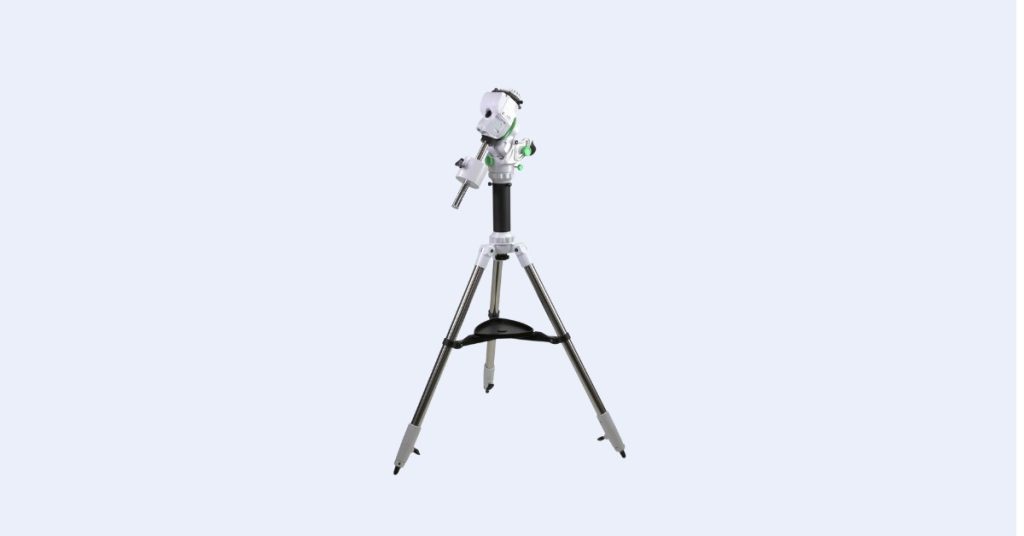
The Sky-Watcher Star Adventurer GTi consists of a compact and lightweight mount head, a polar scope, a counterweight shaft, a pier extension, and a tripod with an accessory tray.
The mount head, which is the main part we’re paying for, does all of the pointing and holds our telescope. The Star Adventurer GTi’s mount head couples to any telescope with a Vixen-style dovetail saddle, which then must be balanced on the declination axis (by sliding along the saddle or in its tube rings) and on the right ascension axis (with the counterweight).
The Star Adventurer GTi comes with a counterweight shaft and a 2.26 kg counterweight, which can be used to balance heavier payloads. The counterweight shaft has to be repositioned on the mount if you are near the equator to avoid it hitting the mount head or tripod. The 20mm diameter of the shaft fits most aftermarket counterweights, but you may need to worry about the width of the weights themselves, as fatter weights may actually hit the mount head.
To help you with polar alignment, the Star Adventurer GTi features a polar scope with a reticle. This reticle is illuminated by the mount when it is powered on. On its own, the polar scope may not always be the most accurate, but you can actually use the SynScan Pro app to help you dial things in by giving a simulated view of what the positioning of the reticle should look like.
The Star Adventurer GTi includes a steel-legged tripod borrowed from the Celestron NexStar SLT telescopes (both Sky-Watcher and Celestron share a parent company, Synta). This tripod is not exactly a beloved part of the NexStar SLT, and it is admittedly a little bit light-duty for the application of supporting an astrophotography rig. However, if the plastic spreader tray is weighed down (sandbags or a full water jug come to my mind) and the tripod legs are kept retracted (which they should be for imaging), I find the vibrations to be minimal.
A pier extension attaches to the ⅜” stud at the top of the tripod, providing greater clearance for the mount and any telescopes mounted atop it to avoid them hitting the tripod.
The ⅜”-16 threaded fittings on the pier, tripod, and mount head mean you can use the Star Adventurer GTi on any sturdy photo tripod, and the stock tripod can be repurposed (as can the pier should you not need it). Alternatively, you can save money and purchase the Star Adventurer GTi mount and pier extension without a tripod if you already have one in mind.
Electronics
The Sky-Watcher Star Adventurer GTi is in many respects a bog-standard Go-To German equatorial mount. It is driven by cheap servo motors, which are not as accurate as steppers. But for a cheap mount designed with high-tolerance (i.e., short focal length) applications in mind, it’s fine.
The mount has Sky-Watcher’s FreedomFind slip clutches and encoders installed, allowing you to manually aim it as you please, and of course features an ST4 autoguide port alongside a USB3 port. There is also a SNAP DSLR shutter control port if you are interested in such things.
The Sky-Watcher Star Adventurer GTi is powered by eight AA batteries, which can last for up to 72 hours of continuous use, depending on the tracking speed and the load. The mount also has a low-battery indicator, which flashes red when the battery level is low, and a power-saving mode, which reduces the tracking speed when the battery level is critically low. Alternatively, the mount can be powered by an external 12V DC source, such as a portable battery or a power adaptor.
The Sky-Watcher Star Adventurer GTi can be controlled wirelessly via the SynScan smartphone app, which can be downloaded for free from the App Store or Google Play. The app connects to the mount via Wi-Fi and allows the user to select and slew to any celestial object in its database, adjust the tracking speed, control the camera shutter, monitor the mount status, and assist with polar alignment. The app also uses the smartphone’s GPS and compass to determine the location and orientation of the mount, and it provides a graphical representation of the polar scope reticle and the position of Polaris or Sigma Octantis, depending on the hemisphere you are in.
Using Star Adventurer GTi for Visual Observation
The Sky-Watcher Star Adventurer GTi can be used for visual observation with a small telescope, which can be mounted on the Vixen dovetail saddle. To use the mount for visual observation, you will need to attach your optical tube to the mount, balance the scope and counterweight, and align the mount with the celestial pole using the polar scope and/or the SynScan app. After aligning on one or more stars, you can then use the app to select and slew to any object in the sky or manually move the mount by unlocking the clutches.
The Star Adventurer GTi is quite a nice mount to use for visual observing—the pier extension helps if you’re using a longer scope, while the FreedomFind encoders allow you to grab the mount and reposition it, providing a seamless transition between manual and electronic pointing.
The Star Adventurer GTi’s 5 kg weight capacity isn’t much, but it’s enough for a 4” refractor, 6” catadioptric, or 6” fast Newtonian optical tube for visual observing. The sturdiness of heavier setups atop the Star Adventurer GTi is greatly bolstered if you can get a beefier tripod than the one supplied, though the stock tripod is fine enough for most purposes.
Using Star Adventurer GTi for Astrophotography
The Sky-Watcher Star Adventurer GTi is designed for astrophotography and can provide smooth and accurate tracking and slewing for wide-field imaging with a camera and a lens.
To use the mount for astrophotography, you will need to attach a camera and a lens to the mount, either directly or preferably via a ball head or a declination bracket. You will also need to align the mount with the celestial pole using the polar scope and the SynScan app and select the appropriate tracking speed. You can then use the app to control the camera shutter or use a separate intervalometre or remote control. You can also use the app to slew to any object in the sky or manually point the mount using the mode dial and the direction buttons. You can then take exposures of the sky and stack them later using image processing software.
The Sky-Watcher Star Adventurer GTi is ideal for astrophotography of wide-field targets, such as the Milky Way, constellations, or large nebulae.
You can also use the built-in autoguider port to connect a guide camera and a laptop and use guiding software to correct tracking errors and keep the object in the frame—or guide directly via your PC, which can also be used to control the entire mount’s slewing and tracking—as well as quickly locate your targets via plate solving and control your main astrophotography camera with software like NINA or Sequence Generator Pro. The Star Adventurer GTi’s ASCOM drivers enable it to easily connect to your PC via a hardwired USB connection or remotely over the mount’s WiFi network.
I would not recommend using focal lengths greater than 600-700 mm atop the Star Adventurer GTi for long-exposure deep-sky work, as even with guiding, this mount and its tripod are simply not up to the task of accurately tracking with a robust setup. Try to keep your rig weighing less than 4 kg or so all included; the general rule of thumb is to not exceed ⅔ of the carrying capacity of the mount stated by the manufacturer when it comes to long-exposure astrophotography.
Should I buy a Used Sky-Watcher Star Adventurer GTi?
The Sky-Watcher Star Adventurer GTi is a relatively new product and may not be widely available on the used market. However, if you can find a used Star Adventurer GTi in good condition at a reasonable price, it may be worth considering. However, you should check the condition and functionality of the mount before buying it, if possible.
