

Mechanics
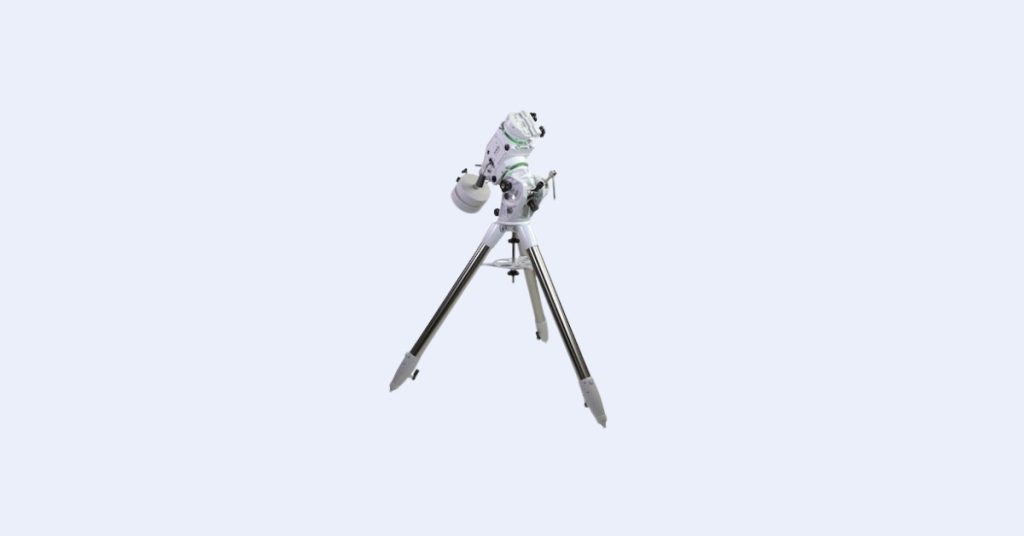
At first glance, the AZ-EQ6 is a pretty standard German equatorial mount, moving in right ascension and declination with precision belt drives powered by stepper motors. The mount’s clutches can be unlocked to balance it or move the entire assembly manually, which can be done with no ill effect on the tracking/pointing accuracy thanks to the AZ-EQ6’s FreedomFind precision encoders.
For use in alt-azimuth mode, the AZ-EQ6 essentially just has its polar axis pointed at the zenith; some counterweight is still necessary with heavier telescopes, but this aspect is less important.
The AZ-EQ6 comes bundled with its own robust tripod, featuring 2” steel legs that are identical to the ones used with most other Synta mounts. This compatibility allows the mount to fit directly onto observatory piers designed for earlier models, making upgrading easy for individuals with observatories considering a switch from the EQ6R, NEQ6, AVX, CGEM, Orion Atlas, and so on.
The mount boasts a counterbalance bar made of stainless steel with a diameter of 25 mm. This will fit most counterweights from other equatorial mounts. The bar’s length is 207 mm (8.25”), extendable by an additional 150 mm (6”) with the supplied screw-on extension bar. The main counterweight bar fully retracts inside the mount head when not in use.
Furthermore, the AZ-EQ6 comes with a standard Sky-Watcher illuminated polar scope already installed at the base of the right ascension (RA) axis. This polar scope includes etchings for Polaris, the Plough, and Cassiopeia for use in the Northern Hemisphere and Octans for the Southern Hemisphere.
The AZ-EQ6 accommodates both Vixen V- (narrow style) and Losmandy D- (wide style) dovetails, along with near-identical CGE-style dovetails from Celestron. Any telescope that uses a standard mounting system can work with the AZ-EQ6, as long as it can be balanced with counterweights and the weight is kept below 20 kg. This means that for less critical (i.e., non-imaging) purposes, the mount can comfortably handle a range of telescopes, including 11″ or 300 mm Schmidt-Cassegrain or Ritchey-Chretien, a 250 mm Newtonian, and even the most substantial refractors and Maksutovs. For long-exposure deep-sky astrophotography purposes, anything over 13.6 kg or so on the AZ-EQ6 is probably going to have issues with stability as well as accurate enough tracking/guiding.
By default, the AZ-EQ6 comes with two 5 kg counterweights, which should suffice for most imaging and visual purposes. Moreover, a DC cord is included for the power supply. Of course, the AZ-EQ6 also comes with a detachable secondary dovetail saddle, allowing you to install a second telescope on the end of the counterweight shaft when the AZ-EQ6 is used in alt-azimuth mode. Due to the flimsier mechanical design of this saddle, I would not recommend putting anything over 6.8 kg on the secondary saddle.
Electronics
A standout feature exclusive to the AZ-EQ6, which functions seamlessly in either mode, is the incorporation of Sky-Watcher’s FreedomFind position encoders. Once activated (they are deactivated by default in the hand controller’s menu), you can loosen the mount’s locks, manually move the mount across the sky, and then lock it back in place. The encoders keep a record of the mount’s position, enabling you to restart Go-To finding. This means that even if the mount accidentally moves or slips in the right ascension or declination, recalibration on alignment stars becomes unnecessary, unlike with most other mounts.
Using The AZ-EQ6 In Alt-Az Mode
If one is considering using the AZ-EQ6 mount for visual observation, they are in for a treat. The mount’s performance is sure to reinforce the value of the investment made in purchasing it.
Transitioning the AZ-EQ6 to altazimuth mode involves tilting the polar axis up to 90 degrees and inserting a bolt stored on the mount into a safety stop to prevent the head from falling back towards the horizontal. This conversion process might not be something you want to undertake regularly. Indeed, you might predominantly use the mount in one mode or another. Nevertheless, having a choice is always a benefit.
You’ll want to be sure that your telescope is balanced on the altitude axis by unlocking the altitude clutch—if the telescope does a nosedive front-first, it’s front-heavy, and if it swings upward, it’s back-heavy. Adjust your telescope in its tube rings (or by sliding its dovetail in the mount head saddle) until this does not occur.
Aligning the AZ-EQ6 in alt-az mode requires pointing it at a few bright stars and confirming that they are centred in the telescope’s eyepiece. There are also “quick align” options such as level north, one-star, or Solar System alignment modes, which are less accurate but will do in a pinch. If you are using two telescopes on the AZ-EQ6, the secondary saddle has thumbscrews that allow you to adjust the precise angle of the second instrument until both telescopes are perfectly in sync.
Using the AZ-EQ6 in Equatorial Mode
The AZ-EQ6 needs to be precisely balanced on both the right ascension and declination axes for use in equatorial mode, a process that involves sliding the telescope back and forth in its rings or along the dovetail saddle for the declination axis (as with balancing on the altitude axis in alt-az mode) and sliding the counterweights on their shaft for balance on the right ascension axis.
For the most accurate slewing/tracking possible, the AZ-EQ6 also needs precise polar alignment. You can use the provided polar scope built into the mount head, but a software-assisted polar alignment routine, akin to the Celestron All-Star Polar Align, is included as an alternative option. This requires aligning at least two test stars (preferably three to eliminate cone errors), followed by choosing another test star. This additional star is selected after choosing ‘Polar Re-Align’ from the hand controller’s menu options and centring it in the eyepiece. After being centred with the direction keys, the routine moves the telescope to an offset position, and you manually recentre it using the altitude and azimuth adjustment bolts. A complex algorithm then corrects any polar misalignment detected in the star’s position.
Using the AZ-EQ6 for Astrophotography
Where the AZ-EQ6 mount truly excels is in its capabilities for astrophotography. Designed with astrophotography at the forefront, it’s a segment where you’ll find most people using this mount. The precision stepper motors, belt drives, and ball bearings in the AZ-EQ6 allow it to achieve sub-arcsecond guiding and make it ideal for anything weighing under 13.6 kg in total payload for long-exposure astrophotography purposes.
The AZ-EQ6 mount is designed to support comprehensive and superior computer control, built upon the open-source astronomy control interface, ASCOM. With ASCOM support, you can use software like EQMOD. EQMOD software provides a connection to the mount using an EQDIRECT cable, thereby eliminating the need to manually enter the time and date into the hand controller.
Using EQMOD also gives you comprehensive control over the mount’s positioning. Plate solving can directly update the mount’s positioning model, removing the necessity of star alignment. Furthermore, you can control the mount using any standard image capture program, such as SGP, NINA, APT, and others. These programs allow you to plate solve (align your mount via images of stars), slew to various targets, and perform meridian flips automatically, offering a seamless astrophotography experience.
Should I buy a Used Sky-Watcher AZ-EQ6Ri?
It is crucial to ensure that key components such as the encoders, motors, etc., are still functioning optimally. If these haven’t been tested prior to your purchase, insist on having them checked to avoid any unwelcome surprises later.
In the event that the AZ-EQ6’s tripod is missing, there’s no cause for worry. A variety of sturdy tripods fitting other Synta mounts fit the AZ-EQ6, and you can always just purchase a pier adaptor too.
Aftermarket Accessory Recommendations
Investing in a PoleMaster could be a wise decision for an expedited polar alignment, as it’s much quicker than using the AZ-EQ6’s onboard polar alignment software or a polar scope and more accurate than either.
In terms of powering your AZ-EQ6, it would be prudent to have either an AC adaptor or a reliable power supply on hand. Consider the Celestron PowerTank Lithium or an alternative rechargeable lithium battery. It’s important to ensure that the chosen power source has sufficient watt-hours and voltage to sustain the operation of the mount over an extended period of observation or imaging.