

Pic by Zane Landers
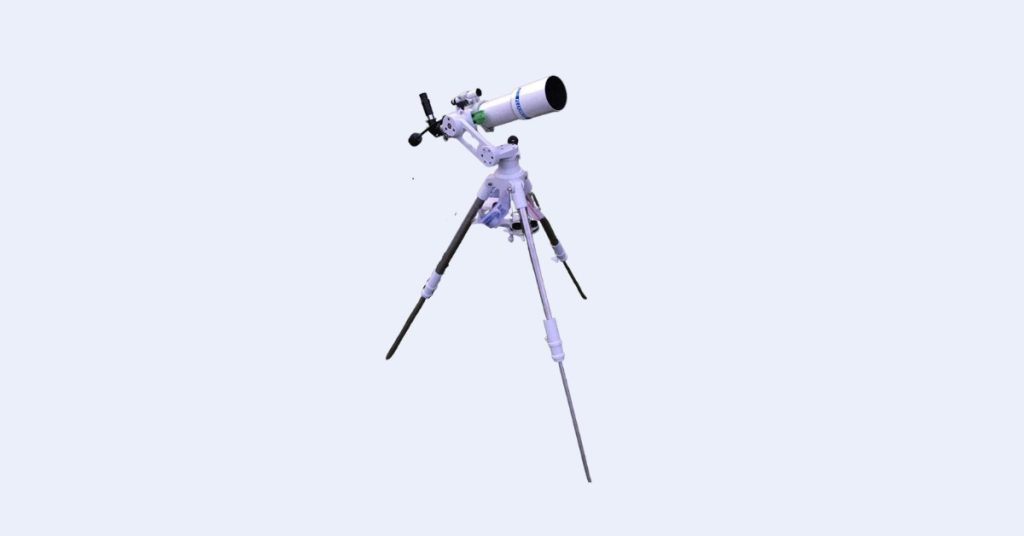
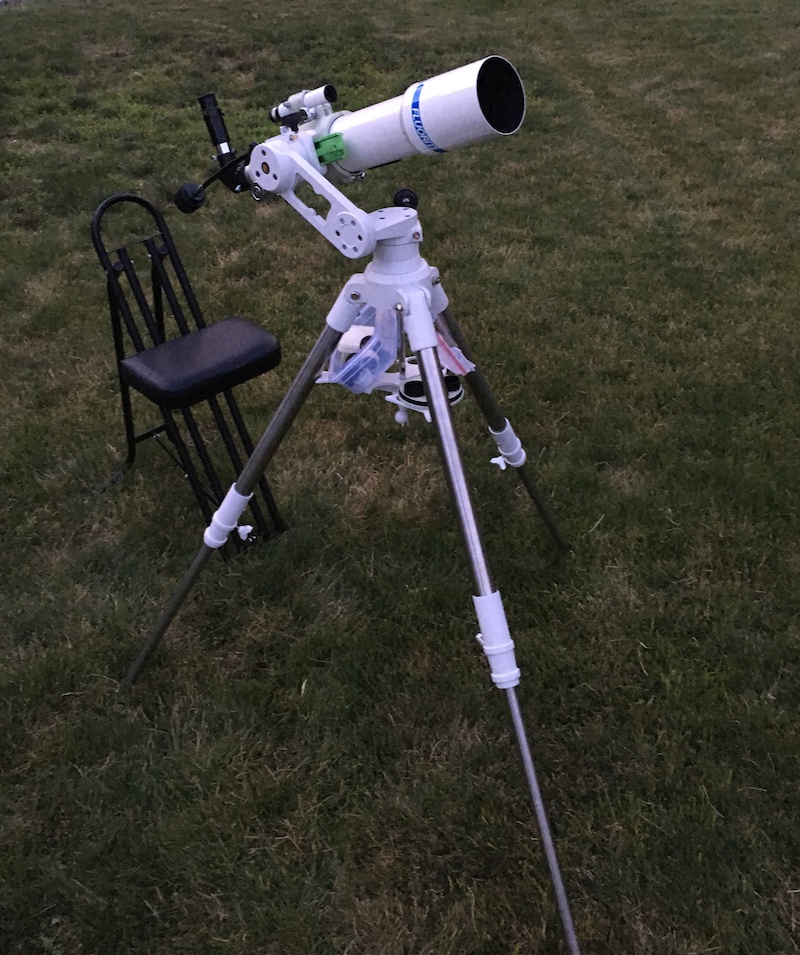
The Explore Scientific Twilight I mount is an alt-azimuth mount that pivots left to right and up/down on ball bearings.
Unlike cheap alt-azimuth mounts based on the design of a fluid head tripod, where the telescope is suspended above the axis of rotation, the Twilight I puts your telescope’s optical tube sideways of the altitude axis. This avoids the common problem of the telescope tipping when aimed high in the sky, which happens with photo tripods and mounts like them due to their inherently unbalanced nature. When you balance your telescope properly on the Twilight I, it remains so regardless of where it is aimed in the sky. There are clutch levers on both the altitude and azimuth axes just in case, however.
While it has a stated weight capacity of 8.16 kg, the Twilight I works best with telescopes under 6.8 kg, including all accessories—so a 6” SCT or Maksutov, a 6” reflector, or a 4-5” refractor is probably the upper limit.
The arm holding the altitude axis for the Twilight I can be adjusted in angle to ensure the back end of your telescope adequately clears the mount’s base; a hex key to adjust the mount is provided and fits neatly in a cover on the azimuth axis.
The Twilight I features standard slow-motion cables to make fine tracking and pointing adjustments on either axis, which is particularly useful at high magnifications. Due to manufacturing tolerances, there can be some backlash/slop in the gears that these cables connect to for adjustment. However, in most cases, this is not a huge concern.
To attach to your telescope, the Twilight I has a standard Vixen-style dovetail saddle that will clamp to any scope with a dovetail bar. The saddle uses a clamping screw with an additional safety screw to firmly grasp your scope’s dovetail plate.
The key to the Twilight I’s stability is its 1.75” steel tripod. This tripod is heavy, but it’s rock solid, and the bottleneck limiting this mount’s weight capacity is solely the mount head. A near-identical tripod is provided with the Sky-Watcher HEQ5, which holds more than twice as much weight as the Twilight I is meant for.
An accessory tray/spreader bar insert provides additional bracing for the legs and has slots for three 1.25” eyepieces—though in most cases you’ll probably not find yourself using it for this purpose.
Should I buy a used Explore Scientific Twilight I?
A used Twilight I has relatively little that can actually go wrong with it, being a manual mount. However, you should, of course, inspect the mount for any obvious corrosion or damage.
Alternative Recommendations
The Twilight I doesn’t have a whole lot of competitors in the manual mount department, so most of our alternative recommendations are GoTo mounts, which also allow manual adjustment, though without mechanical fine adjustment controls they aren’t exactly ideal for a purely manual configuration.
Under £300
- The Sky-Watcher AZ-GTi has a lower weight capacity than the Twilight I, but not by much—it’s still more than capable of holding smaller scopes up to 4.5 kg. The AZ-GTi features motorised tracking and GoTo—operated by your smartphone/tablet at that—and can easily be set up in just a few minutes to automatically point at and track objects, or you can loosen the mount’s clutches and aim it manually thanks to its FreedomFind encoder system with no compromise to its automatic pointing and tracking accuracy.
- The Sky-Watcher AZ5 has basically the same features and design as the Twilight I with the bonus of a provided pier extension, but it does not permit as much clearance with longer/wider telescope tubes as the Twilight I, nor is it quite as easy to pick up and carry around.
£300+
- The Sky-Watcher AZ-EQ6 is a marvel of modern telescope mount technology, deftly combining functionality with ease of use. It possesses the capacity to transform from an equatorial mount, which is an optimal setup for astrophotography, to an alt-azimuth design that’s well-suited for visual observing. In addition, the Sky-Watcher AZ-EQ6 incorporates FreedomFind technology. This innovative technology allows you to manually aim the telescope, independent of the computer control, without losing alignment or positional information. It combines the benefits of GoTo pointing and tracking with the immediacy and convenience of manual telescope movement, a feature that many observers find invaluable.
- The Sky-Watcher AZ-EQ5 GT features the same design features as the larger AZ-EQ6 but in a more compact package with a 13.5 kg weight capacity, again on either side of the mount. Like the AZ-EQ6, it’s a great mount for both heavy visual use and imaging with lighter payloads.